Every active SKU gets a risk status Reprint now, Watchlist, Monitor, or No action.

The problem
Two risks, pulling in opposite directions.
Deciding a reprint means constantly arbitrating between two asymmetric risks: stockout lost sales, delisting, broken momentum on a title on the rise and overstock cash tied up, unsold copies, pulp.
Today this is done by hand, title by title, often too late, and without any consolidated view of the portfolio. The Reprint Engine turns each situation at risk into a structured decision: when to reprint, how many, with which technology.
What the engine produces
Four deliverables that go straight into your workflow.
-
1.
Portfolio triage
-
2.
Two costed scenarios
A fast run that secures availability, and a deferred run that optimises unit cost fully comparable.
-
3.
A motivated call
An explicit, tunable arbitration rule picks between the scenarios with a costed rationale.
-
4.
A standardised alert
One JSON object, consumed by every surface of the suite portal, alerting, printer exports.
The recommendation · explicit rule
Fast, deferred, or deferred with a buffer decided by a rule you can read.
No black box on the decision that matters. The engine applies the same three-step rule to every alert, with thresholds governed at group level.
-
1.
Deferred is safe
If stockout risk while waiting ≤ 15% → take the deferred run and its better COGS.
-
2.
A buffer bridges the wait
Else, if a POD buffer cuts residual risk ≤ 10% for less than the FAST/DEFERRED gap → deferred + buffer.
-
3.
Availability wins
Otherwise → fast. A stockout on a rising title outweighs a degraded unit cost.
Under the hood · simulation
Risk measured on thousands of futures not a formula.
Instead of summarising the future with a mean and a standard deviation, the engine replays hundreds of demand trajectories consistent with the forecast, and counts what happens: in how many futures does stock hit zero before the reprint arrives?
It consumes the forecast's P10 / P50 / P90 quantiles directly the same band shown in DS Agent and handles intermittent long-tail demand, fractional lead times and reinjected returns natively.

Governance
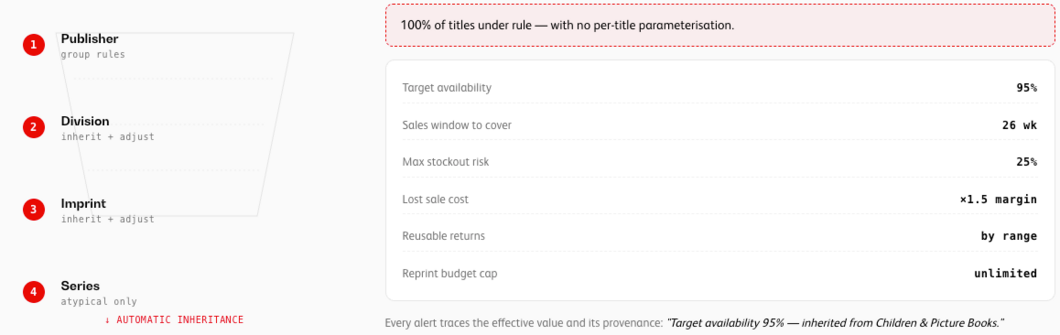
Your objectives, inherited down the editorial pyramid.
Business parameters are set once at the top and flow down Publisher → Division → Imprint → Series with override at any level. The same mechanic as Print Run's publisher objectives: whoever configures one configures the other.
In one sentence
Catch the stockout before it happens not the week after.
Two scenarios, one rule, a costed rationale the decision stays yours.
The reprinted quantity does not exist until it arrives and the engine never pretends otherwise.
The whole backlist under rule, every night, at the cost of a handful of simulations.
To be clear
What this module does not do.
✗ It does not raise the purchase order the engine proposes, the order stays human.
✗ It does not forecast demand that is the upstream engine, consumed via a contract.
✗ It does not model shop-floor stock only the distribution centre, in V1. Stated up front.
For whom?
-
Editorial & Supply director
Cut waste without risking stockout, harmonise reprint policy across imprints.
Decision-maker · buyer -
Print buyer · Portfolio manager
Act on a short, ranked list of alerts each with a sized, costed, explainable decision.
User · operator