In-store rollout. Quantity distributed at title release.
The problem
Today, the N+1 budget is built in Excel. And it doesn't hold.
At the end of the cycle, finance and controlling teams in a publishing group must build next year's budget. Data from multiple sources, arbitrages between scenarios ("what if we bet more on new releases?"), dual publisher/distributor view, ERP exports: all of this is currently done in Excel.
Every scenario requires a copy of the file, original data is overwritten, it is impossible to maintain several hypotheses in parallel without chaos.
What Excel cannot do
- Hold N scenarios in parallel without copy/paste
- Guarantee the integrity of original data
- Maintain the dual publisher / distributor view in parallel
- Track who modified what and when
- Compartmentalise access by scope
- Validate product references before insertion
Capability 01 / 06
Two-stage Excel import. Zero silent corruption.
The budget is fed by a structured Excel import - your teams keep preparing data in the tool they master. But the import goes through two validation stages before any insertion in the database.
Stage 01
Reference check
DemandSens checks that all codes exist in the system: publishers, divisions, collections, hubs, lists, companies, VAT codes, reference EANs. Detailed error report on inconsistency.
Stage 02
Database insertion
Only if validation is clean. No silent import of a malformed file. No data corruption.
Capability 02 / 06
Variance rules: simulate without overwriting, N parallel scenarios.
The module's central feature. A variance rule applies a variation percentage (-30% to +100%) to a driver, restricted to a precise scope. Original data is never modified: every rule creates new simulated flows that coexist.
-
Rollout
-
Restock
Replenishment orders.
-
Net sales
Actual sales, returns deducted.
-
Returns rate
Forecast waste percentage.
Capability 03 / 06
Dual publisher / distributor scope, in parallel.
Every budget line is computed simultaneously under two perspectives. Publisher and distributor have different forecasts and constraints on the same products a single Excel file cannot hold them properly in parallel.
-
Publisher
How much we manufacture. How much we forecast to sell.
-
Distributor
How much we commit to distribute. How much comes back.
Capability 04 / 06
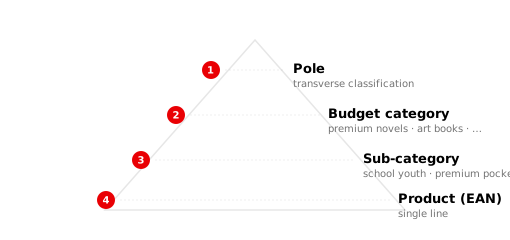
Editorial budget pyramid distinct from the product hierarchy.
A classification dedicated to the budget, independent from the standard product hierarchy (collection / series). Lets you arbitrate by budget category (e.g. "premium pocket novels", "art books", "school youth") closer to actual financial steering.
8 budget allocation modes
- Reference
- Series
- Collection
- Division
- Publisher
- Region
- Pole
- Pyramid
Capability 05 / 06
Fine monthly breakdown. Statuses tracked per scope.
Annual budget quantities are broken down into 12 months (plus an "off-calendar" month for atypical launches). Completion statuses are tracked separately for the publisher and the distributor scope the user immediately sees where work remains.

Capability 06 / 06
Multidimensional analysis + 4 multilingual Excel exports.
Drill-down navigation with personal layout saving. Each user finds their view back.
4 Excel exports · FR / EN / DE
| Global | Consolidated view of the group budget |
|---|---|
| Per-publisher detail | Budget broken down by publisher |
| Monthly breakdown | Budget allocated across 12 months |
| Per network | Budget allocated by distribution channel |
Governance & access
Granular RBAC everyone sees what their scope allows.
-
budget_full_access
Full access: budget creation, variance rules, exports, RBAC.
-
budget_publisher
Restricted to one or more assigned publishers.
-
budget_read_only
Read-only, exports allowed, no modification.
Budget · in one sentence
Simulate without overwriting: your original data stays intact.
N parallel scenarios, zero data loss.
Publisher or distributor, the same truth in a single tool.
Excel for import, SaaS for governance.
From EAN to hub, every budget line is traceable.
To be clear
What this module does not do.
✗ It does not replace the ERP for accounting and financial closing.
✗ It does not handle payroll or fixed group costs.
✗ It is not a BI tool - it exports to existing BI tools.
For whom?
-
CFO · Finance director
Consolidated visibility on the N+1 budget, ability to arbitrate between scenarios, reliable quarterly reporting.
Decision-maker persona · buyer -
Controller · Budget manager
Build and simulate the N+1 budget, monthly breakdown, exports to ERP and reporting.
User persona · operator