parameters consumed

The problem
Decide a print run before publication. With very little certain information.
Every new title needs a print-run decision: how many copies to print? This decision is made before publication, on the basis of very little certain information. Publishers traditionally rely on experience and informal comparisons with past titles.
DemandSens formalises and automates this comparison through the notion of comparable titles: a past title, comparable to the new one, used as the basis for calculation.
Feature 01 · Comparables Engine
Identify truly comparable titles, across the entire catalogue.
For every new title, the engine computes a similarity distance against all titles in the catalogue (group, same publisher, external publishers), and surfaces the closest ones as candidate references. Automatic or manual selection, up to 3 references kept per title.
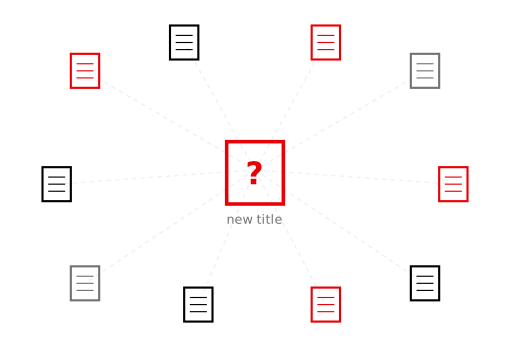
Structural metadata
- Author
- Product type
- Classification (Thema · CLIL · BISAC)
- Publication date
- Publisher · Collection
- Format · Pagination
- Price
Content & description
- Excerpt
- Summary
- Keywords
- Theme
Market signals
- Author's historical performance
- Collection dynamics
- Seasonality
Feature 02 · Machine Learning Engine
200+ parameters. Three specialised engines. Continuously retrained.
The DemandSens ML engine consumes more than 200 parameters, a large share of which is built by DemandSens as proprietary derived features (not just raw inputs). The model is versioned, retrained and redeployed automatically, with no intervention on the publisher's side.
-
1.
Ingest
-
2.
Prepare
Enrich · Standardize · Cluster
-
3.
Model
Train · Optimize · Validate
-
4.
Deploy
Ensemble · Validate
-
5.
Expose
REST API · Run · Maintain
200+
~70%
DemandSens-built features
auto
retraining & redeployment
3
specialised engines exposed via API
Feature 03 · Module Core
Three scenarios, three commercial hypotheses.
The model produces three distinct forecasts, matching three hypotheses. The publisher picks the one matching their moment in the cycle.
-
1.
Baseline scenario
Forecast without commercial objectives
When To Use It: Neutral starting point, "natural market" view
-
2.
With commercial objectives
Includes commitments from sales teams
When To Use It: When KAMs have already quantified their commitments
-
3.
With trend
Includes current market dynamics (uptrend or downtrend)
When To Use It: Mid-cycle, to readjust
Feature 04 · Explainable AI
Quality score. Drivers explained. Decision always human.
Every forecast comes with a reliability score indicating the recommendation's reliability, based on reference relevance and data availability. The influence parameters are explained and weighted: the publisher sees exactly what pulls the forecast up or down.
The AI recommendation is explainable. The publisher understands why DemandSens recommends a given number. The final decision still belongs to the publisher.
6 forecast drivers
- Author performance - 92%
- Collection dynamics - 78%
- Book theme - 64%
- Sale price - 58%
- Catalogue density - 41%
- Series trajectory - 87%
Feature 05 · Governance
4-level editorial pyramid. Automatic rule inheritance.
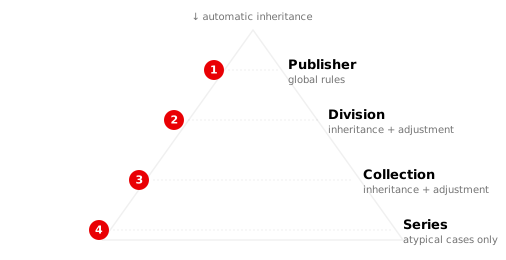
DemandSens organises the catalogue along a 4-level pyramid. Calculation rules are set at the top level (publisher) and inherited automatically downwards. The user only intervenes for collections or series with atypical behaviour.
Result: 100% of titles under rule, with no per-title parameterisation.
Print Run · In One Sentence
The right print-run decision, grounded in real comparable titles not in intuition.
Cut waste without risking stockout.
An AI recommendation, but the decision stays yours.
All your titles under rule, thanks to editorial pyramid inheritance.
To be clear
What this module does not do.
✗ It does not decide for the publisher.
✗ It does not replace editorial judgement on a manuscript's value.
✗ It does not predict "hits" unforeseen events, sudden media buzz.
For whom?
-
Editorial director · Distribution director
Cut waste without risking stockout, harmonise rules across imprints.
Decision-maker persona · buyer -
Print run lead · Product manager
Decide a print run in minutes, with reliable, explainable comparables.
User persona · operator